Tiger Country
Two and a half weeks in Nepal: the Kathmandu Valley, the Annapurna foothills, then eight days in Bardia National Park looking for wild tigers.
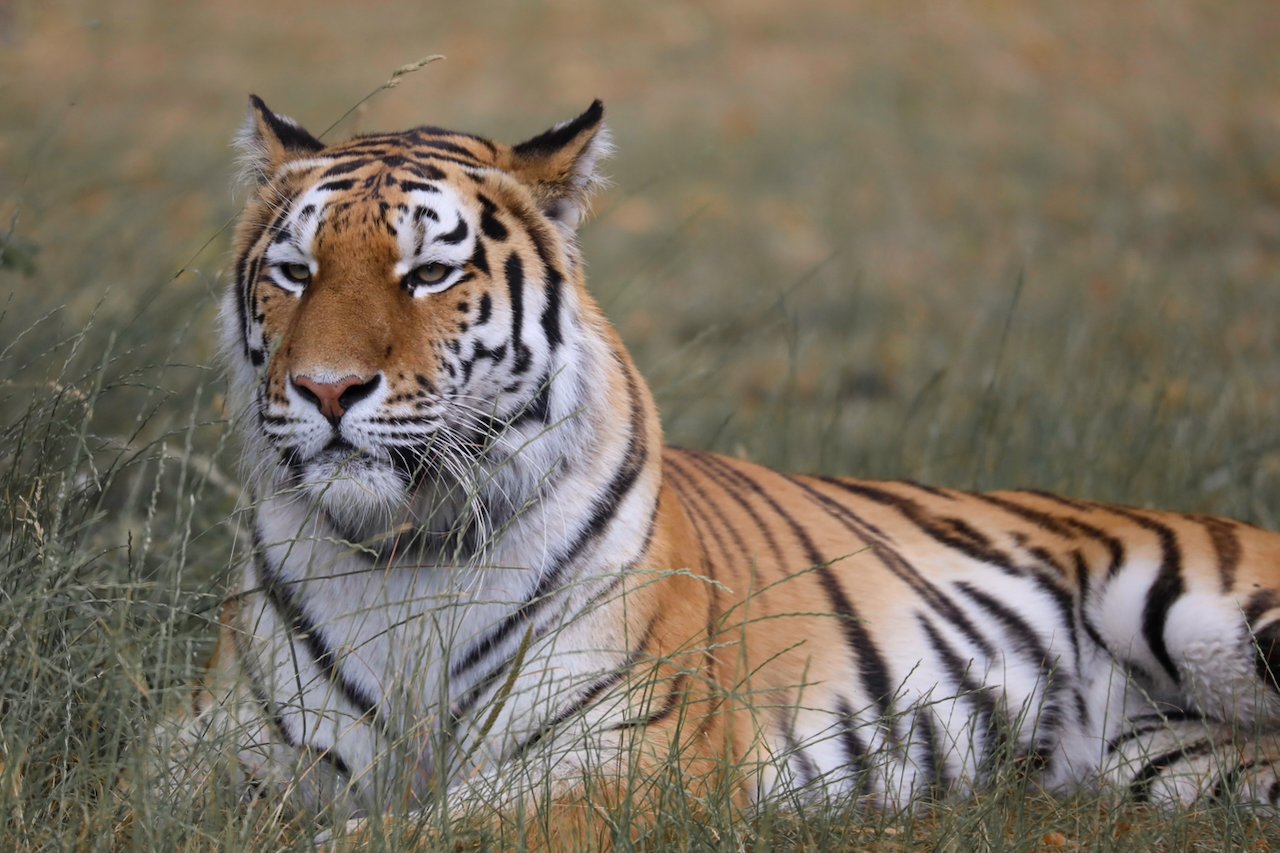
To date my only encounter with a tiger has been in a UK wildlife park, where this Amur tiger lay watching me through the long grass. From 14 to 30 November I will be in Nepal to track its cousin, the Bengal tiger, in its natural habitat, and the best chance of that lies in Bardia National Park, in the far west of the country.
The trip starts in the Kathmandu Valley — Boudhanath stupa and the old squares of Bhaktapur — then moves west to Pokhara and the Annapurna foothills, before the long road down to the Terai, the band of lowland forest and grassland that runs along the Indian border.
Bardia is the largest national park in the Terai: 968 km² of sal forest, riverine grassland and the braided channels of the Karnali and Babai rivers. It sees far fewer visitors than Chitwan, its better-known neighbour to the east. I will be based at Mango Tree Lodge, a small family-run lodge in Thakurdwara on the park's edge, whose owners have spent years as jungle guides. The eight days mix walking and jeep safaris inside the park with a river trip on the Karnali. On foot, tracking means reading pugmarks and scrapes along the riverbanks and listening for the alarm calls of deer and langur.
It is also one of conservation's genuine success stories. Nepal's wild tigers have more than tripled since 2009, from 121 to 355 in 2022 and 429 in the latest national survey, with 112 of them in Bardia. Greater one-horned rhino were moved here from Chitwan from 1986 onwards; poaching almost wiped them out again in the 2000s, and the population has since been rebuilt under tighter protection. The rivers hold gharial and the Gangetic river dolphin, and the floodplain has its own herds of wild elephant.
Success brings its own problem: more tigers means more encounters with the farming villages on the park's edge, and human-tiger conflict is now one of Bardia's biggest challenges. It is a theme I expect to follow into India with the Centre for Wildlife Studies next year.
From Bardia it is back to Kathmandu and on to Kyrgyzstan on 1 December, swapping the Terai's grassland for the snow of the Tien Shan.